Lawful Deviation in the Line of Falling
My relation with the "official" lineage
Plavan N. Go
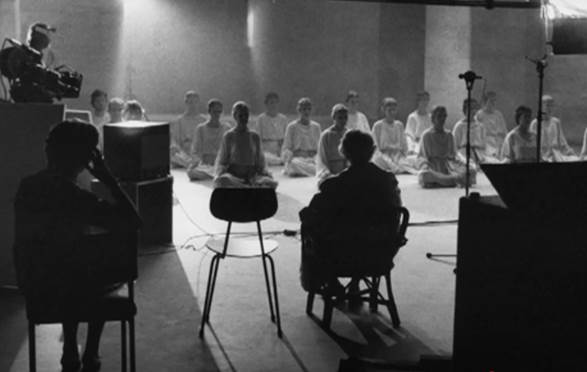
Last days of
Movements practice
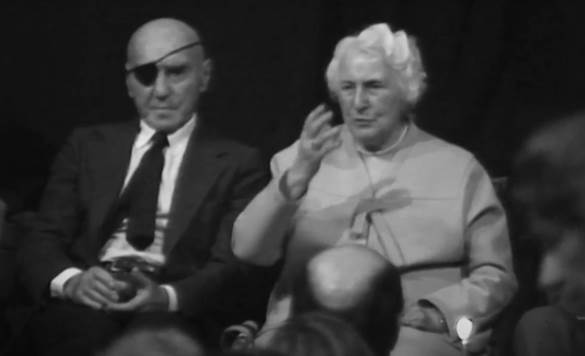
Mme de Salzmann with William Segal, known in Japan
as advisor to Kanebo and for his association with Zen authorities,
who became a chief source of Eastern influences to Jean
and became like mentor to her son Michel
In the following section, I made unusually extensive quotations from "Movable Feasts: The Gurdjieff Work" published on Religion Today (London) IX (2) in 1994, on account of which Moore was excommunicated from the Gurdjieff Society. Such extensive quotations, I think, may be found justified because of the following conditions in which I have been personally involved:
(1) An insider's account like this is required for anyone today to understand the background of what may appear as irregularity after 1990 in the course of passing down of the Movements (sacred dances) from Gurdjieff: the dwindling of practice in the Salzmann's lineage and the attempts toward toward revival in the Osho's Commune from 1990 to around 2003, before the period of quick and gross commercialization from around 2003.
(2) Also, the article suggests the background of the scandalous loss of the most precious but heavily guarded archives of Movements notes and videos produced by earlier efforts of Madame de Salzmann. In 2003, evidently in reaction to the discovery of the loss, several "outsiders" including myself who were suspected to be in possession of materials "stolen" from them, were legally blackmailed by a lawyer claiming to represent the Institut Gurdjieff, and in my case, was told to hand them over by an email, to which was attached an obviously fake or invalid letter from JASRAC, stating that "the copyright of the French author of your inquiry" is still protected under the Japanese copyright law. (I don't think that Gurdjieff can be legally considered a "French" author unless he was finally granted French nationality, which appears to be not on record.)
Some complied while I did not. Instead, they asked me if I could lead for them a two-day Movements practice event in Fontainebleau. To this, I complied, and witnessed what looked at the final state of the Salzmann tradition after the death of Michel de Salzmann in 2001. By the way, the cause of the loss of the archives was explained to me then as "flood" at that time. Afterward, from Dushka Howarth, a daughter of Gurdjieff, I learned that it was not like that: the two sets of identical archives were one day found missing from their safe depositing vaults in Paris and New York. Who do I suspect? I should not say. Recently again, I was warned "You ask too many questions." from a man who was showing on YouTube a tribute video to Gurdjieff, which claims to have been produced according to the "concept" of Michel de Salzmann, but had long been banned from release. My suspicion about him first arose from the heavy, almost criminal censoring I found in the English translation of the manuscripts left by Tchesslav Tchechovitch, which were inconveniently found at the end of the 1990s, and the editor acknowledges that the censoring was done under the direction of Michel de Salzmann.
From my personal contacts with the lineage, like participation in "work" events led by J. S., who had been leading groups with James Moore before the latter was expelled. As James Moore states, there seemed to have been a general ban on the mentioning of Gurdjieff and the use of materials that directly come from him. No use of written materials from Gurdjieff, no music from Gurdjieff, no practice of the Movements. Instead, there was a practice of drawing straight lines by handwriting, as neatly as possible, probably an exercise in super-effort originating from Henriette Lennes; reading of a poor composition by a certain student in the Work; listening to some oriental music after which we were to share special impressions we might have received. On the other hand, the inner exercises he shared was not as bad as Moore describes, and I did not find them so scandalously "incongruent" with Gurdjieff as I found them in line with similar exercises Gurdjieff taught in late years to Salzmann and French pupils were, the knowledge of which seems to be lacking on the part of Moore.
Moore, in his miserably titled autobiography: Gurdjieffian Confessions: A Self Remembered (2005), went deeper into the history of glory and fall of the Salzmann lineage after the death of Gurdjieff. Unfortunately, the number of printed copies was small and now stocks are sold at an astonishing price.
* * *
Excerpts from Moveable Feasts: The Gurdjieff Work
© 1994, James Moore
Let us now soberly test for deviation and revisionism in one specific NRM [new religious movement] namely 'The Work', i.e. the spiritual movement initiated by George Ivanovitch Gurdjieff . . . boasting a primary and secondary literature; and exerting a subterranean ideological and cultural influence. The Work is apt, indeed ripe, for survey. Gurdjieff himself counselled no-one to loiter in an unexamined 'Gurdjieffianity': "If you have not by nature a critical mind your stay here is useless"
Our basic parameters are relatively straightforward—reserving judgement on a plethora of foreign and fringe organizations, we focus on the Work's mandated UK vehicle, The Gurdjieff Society, in the 40 years between the deaths of Gurdjieff (29 October1949) and his effective successor Jeanne de Salzmann (25 May 1990) . . .
The Stoic Legacy
The historian's starting point is not what Gurdjieff is in any value-system . . . the issue is what he actually said. His compassion, humanity, humour, even occasional tenderness, are amply documented—but as the context of his didactic rigour. 'The Work' . . . implies virile and inescapable endeavour. "Ordinary efforts do not count", exhorted Gurdjieff. "Only super-efforts count . . . it is better to die making efforts than to live in sleep".
In memoirs of early English pupils: "The keynote was 'Overcome difficulties—Make effort—Work'". . . The fact that the traditional Gurdjieffian's attention is, ever and again, self-mobilised for uncompromising interior Jihad, has licensed martial metaphor in book titles by disciples (e. g. Thomasson's Batailles pour le présent [Battles for the Present]) and by outsiders (e. g. Wilson's War Against Sleep.
Incontestably, Gurdjieff insisted on spartan exercises (e. g. counting in cannon; fasting; 'Arms-sideways') and dance forms ( e. g. the Arch-difficile'; the 'Ho Ya! Dervish') which challenge human potential . . . His personal energies he committed à l'outrance [abundantly in excess] and, when he died, his pupils swore fealty in terms resonating the unequivocal vibration of their master's 40 year ministry:
The stringency of Gurdjieff's methodology flowed from his model of the universe or 'Ray of Creation'. This hierarchical cosmicization of being, with its startling involuntionary solfeggio (DOminus the Lord, SIdera the stars, LActea the Milky Way, the SOLar system etc.) . . . Significant, however, that in the Ray's downward cascade, the ratio of grace to blind mechanicity worsens incrementally – only such a bare minimum reaching earth as may prompt and empower a few seekers' arduous ascent towards its pure and abundant source: Hic opus, hic labor est. [So, the ascent has to be work, it is work.: Precisely this paradigm softens and illuminates Gurdjieff's strange dictum that his is an orientation "against nature, against God"
Such then the stoic legacy, which on Gurdjieff's death passed onerously into the worldwide stewardship of his closest and most senior pupil Jeanne de Salzmann.
The Thirty Years War
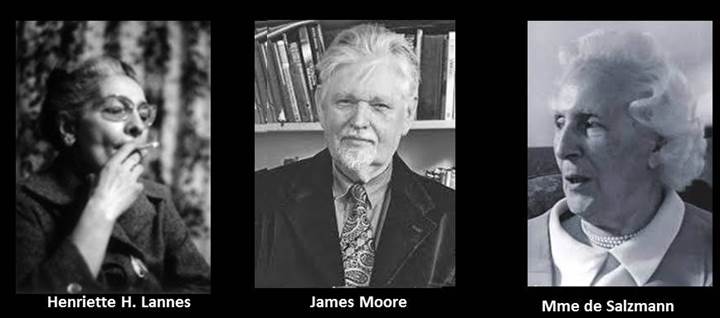
In the magnetic individuality of Mme Henriette H. Lannes (Mme de Salzmann's chosen representative and plenipotentiary in England for 30 years) the traditional Gurdjieffian ethos of effort was personified and guaranteed. It was vibrantly present in demonstrations of Gurdjieff's Sacred Dances. It informed a bewildering range of ancillary activities from a marionette theatre to a Work-oriented study of science . . .
That she instigated moments involving confrontative physical challenge in Gurdjieff's line of 'supereffort'is undeniable; yet it was not through ordeal, through prodigies of asceticism that Mme Lannes manifested. In dramatic, interactive exchanges, conducted with ruthless compassion, she brought a teaching of individuation, wherein each pupil was granted unique specificity, both as merde de la merde [shit of shit] and as candidate for 'self-perfection in the sense of being'; a teaching which elevated the taste of 'I am' from cheap egotism to an essential presence replete with noetic content.
Nor, of course, was Mme Lannes alone. Throughout this long formative period all authoritative Work voices endorsed, without a shred of reservation, Gurdjieff's canon of effort, striving, and self-reliance. It furnished the express idiom, verbal and kinetic, of a succession of exacting Movements teachers (Rose Mary Nott, Solange Lubtchansky, Nicole Egg, Marthe de Gaigneron).
In these very terms Mme de Salzmann maintained her personal notebook: "Such is my struggle: a struggle against the passivity of my thought. A struggle without which nothing more conscious . . . could be born" (1958).
In these very terms Peter Brook introduced his biographical film Meetings with Remarkable Men: "Gurdjieff's life points us to another struggle . . . the struggle to be" (1976). In these very terms Henri Tracol (an eminent Gurdjieffian) commended to the searcher: "A voluntary concentration on struggle – a struggle for which he himself is the ground" (1979) . . .
Such was the consistent and amply traditional tenor of The Gurdjieff Society's 30-year primary epoch, which closed decisively at 10 p.m. on Wednesday, 28 May 1980, when H. H. Lannes died.
Amazing Grace
London's grieving members took heart from unchanging group modalities. Continued visits by the revered teachers Henri Tracol and Maurice Desselle – and above all Mme de Salzmann's on-going supervision – seemingly augured [promised] doctrinal and methodological stability.
Yet the augury misled. The Work's familiar form increasingly delivered a novel content: Plus c'est la même chose, plus ca change. [Just be as you are, then you will change.] Individualised teaching was out, general doctrine in; the wood was everything, the trees nothing. Fronting the new doctrine was an modulation of idiom from active to passive voice: the pupil no longer 'remembered himself' but 'was remembered'; no longer 'awoke' but 'was awoken'. Pupils did not, need not, could not, work: they were 'worked upon' (even while they literally slept!).
These startling propositions advanced with formidable intellectual refinement by French teachers of palpable integrity, left questions. Who could deny, and who fulfil, the residual demand for a subtle interior attunement? . . . Even so, the traditional Work paradigm was undeniably bouleversé: Yang converted to Yin . . .
. . . the iconic Gurdjieff, avatar of effort, now necessarily fell to be deconstructed by his eponymous organisations. Thus, at a time when the crypto-Gurdjieffian journal Parabola continued celebrating a vast pantheon of religious, mythic, and legendary figures, Dr Michel de Salzmann (Mme de Salzmann's son) warned of Gurdjieff himself that, "there are no golden legends to be built around him." Then, if not legend, perhaps sober history was admissible? Seemingly not: Gurdjieffian historicity was equally unwelcome in Paris because "rather idolatrous."
Effectively discarded with both the 'heroic' and historical Gurdjieff was the entire apparatus of his Systema Universi: the Ray of Creation, the Table of Hydrogens, the Step Diagram, the Food Diagram, the Enneagram, etc. They and their unwelcome implications simply vanished from politically correct discourse.
With this final solution to the problem of the Work's effort . . . the pupil's presumed new experience of 'being worked on' and 'being remembered' was posited in a mystical illuminism, which hinted encouragingly at a supernal 'look of love' . . . . fusion with this supernal source replaced individuation as the pupil's goal. In regular communal 'sittings' the highly energised 'love from above' professedly entered the pupil's subtle body through an 'aperture' at his crown . . . as he waited with eyes closed in still, sustained, and intensely refined attention . . . With each vital breath his transforming energy ducted itself ‘arterially’ down the spine into the sexual zone . Though the French teachers scrupulously eschewed Yogic terminology, its inescapable redolence sat incongruously with Gurdjieff’s fierce strictures against Indian religiosity in general (a “bordel for Truth”) and Kundalini in particular.
Watch This Space
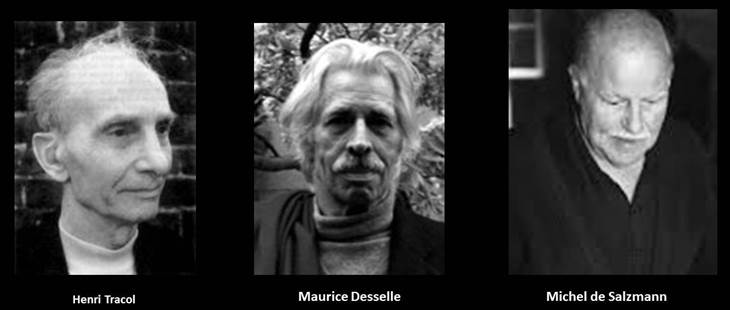
Then, all in all, what had happened? And why? A tradition's thirty years' staunch conservatism, then abrupt deconstruction, by diametric inversion of logo centrism, begs analysis . . . group loyalties, hierarchical organisational structures, patterns of sanction and patronage, and, above all, a well-founded awe of Mme de Salzmann muffled dissent . . . the Work's post-1980 cultural revolution in Britain was instigated not by its 'Red Guards' but by its 'Great Helmswoman'. Jeanne de Salzmann was an active and formidable 90, and her London delegates Tracol and Desselle in their 70s, when all three commenced dispensing the new doctrine unanimously, simultaneously, and in manifest good faith. Given the Work's ethos of symbiotic paternalism, explanation was neither demanded nor volunteered.
Nevertheless, the vast residuum of the Gurdjieffian oeuvre seems – after scarcely 40 years – already overcast by his own sombre observation, that every religious movement's trajectory eventually "deviates from its original direction and goes . . . in a diametrically opposite direction still preserving its former name".
Jeanne de Salzmann died on 25 May 1990 aged 101, having heroically given her last reserves to the Work's future. But what future? Paris's tenacious hold over matériel and 'orthodoxy'; the existence of an extensible dynastic line (through Dr Michel de Salzmann); and the current well-meaning series of international, oecumenical conferences . . .