|
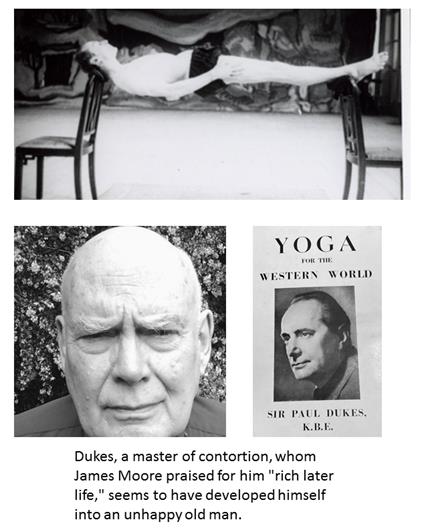
Epoxides from The Unending Quest by Pau Dukes
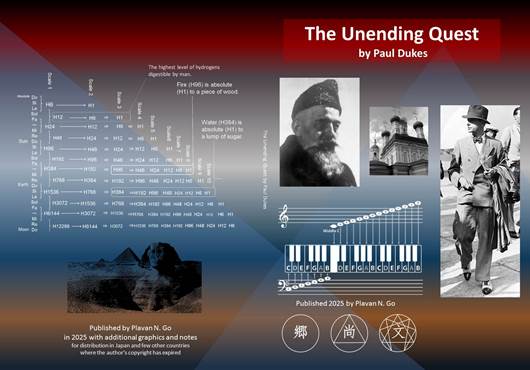
Available from Amazon in JP, CA and AU. See a related video on YouTube. 1. Bad Start
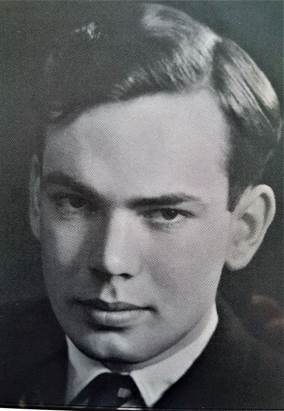
An exchange between Dukes and Ozay (Gurdjieff): Dukes: 'My father was a parson [priest]' Ozay: 'Ah, you had a bad start. One does not expect divines to understand the Bible. They cling to the text.' (from Chapter 7) Dukes seems to demonstrates this with he own preaching, which emphasizes the importance of perfecting one's body as an instrument to serve the higher, with readiness to submit to the evil: . . . special exercises contained in the Sermon on the Mount and other portions of Christ's teaching—not to resist evil but turn the other cheek not to resist evil but turn the other cheek, to pluck out eye and cut off hand that offend, to confine speech to yea and nay, to take no thought for the morrow—all such exercises are essentials of Yogic training . . . (from Chapter 17) What does this translate into sexually? When I was sent to a small public school my musical ability ceased to be a singularity and became a distinction. I was happier. Yet many circumstances both of home and school conspired to reinforce the tendency to reserve, not to say secretiveness. Among these were the unwelcome attentions of a master [teacher] whom I dared not antagonize by open repulsion and whose fondling I suffered for a long time in agonized frigidity until he at last gave up and transferred his attentions to another. He was a highly cultivated man whose friendship I otherwise valued, which only made the position more difficult. (from Chapter 1)
It formed a peculiar character which he interpreted as blessing: I discovered that despite my timidity I could often achieve my aims by patience, dissimulation, and pretense—qualities which at a less sordid level often become known as tact, diplomacy, and resource—and these served me well in later years, even after I had acquired a bit more pluck, though I am bound to confess that during boyhood I made use of them in their baser form for purposes less justifiable than deceiving an importunate master! (from Chapter 1) It looks like that he never dared to openly rebel against what he calls the "totalitarian severity" of his father and the Bible that he says was "rammed down" his throat. His choice seems to have been to adapt, deceive, dream, and escape: Taken all in all, these experiences inclined me at an early stage towards the mystical, and created the need to evolve a philosophy of my own, independent of upbringing. Soon after I left school the feeling gripped me that I must break away—anywhere—in any direction. (from Chapter 1) Deception, charlatanry, and sham mysticism seem to have been the basic elements of the air he breathed from the beginning of his endless quest. Secretly escaping home while his father was in honeymoon with a new wife he married in his old age, he travels to Netherland, where he meets a language school director for an interview. The director finds him inexperienced, but then gets an idea of making him look bigger than what he was using the title of Lon. Mat. (London Matriculate). This means nothing more than a person whose completion of high school education and qualification to enter a collage has been certified by London University. However, foreigners who come to learn English are unlikely to know this and are impressed by the title. So, this small incident at the age probably of around 18 set him toward the path of becoming Uncle Moon, a mystical healer in ta Russian village attracting helps of good spirits with the Lord's Prayer, which is likely to have appeared to Ozay as the misuse of the Name, and toward serving the country through deceptiveness as an M16 secret agent, which won him the title name of K. B. E. (Knight Commander of the Order of the British Empire). A few years after this, he was in Riga, trying to start up a branch institution for Dr. Kummer, a charlatanistic language school operator, serving as his good instrument, in the spirit of not resisting evil, which is despised by two roguish Italian and Spanish language teachers he hired: 'Time for suckling babe to have its mother's milk, isn't it? . . . [he should] get a nurse to come and hold his hand . . . and put him to bed . . . [or] go to bed with him . . . to teach him . . ' (from Chapter 2) What they were telling him was curiously predictive, because he found one after a few years in St, Petersburg, until then, it seems, he did not know woman:
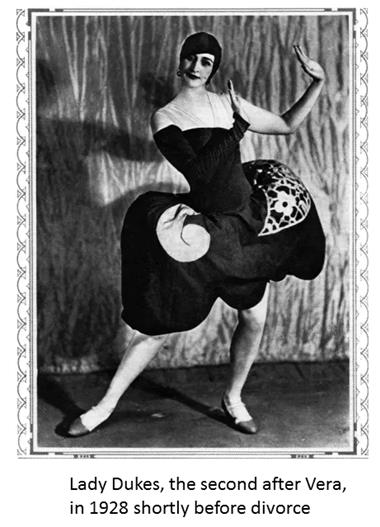
During the latter part of my student days and up to the outbreak of the revolution my life was secretly dominated by a remarkable and very beautiful woman whom I shall call simply Vera / . . She sprang from an ancient line and her youthful marriage had been one of convenience to a man who turned out to be a confirmed drunkard. She never actually quit her debauched and degenerate husband—out of pity more than anything else—but it was many years since they had lived together. She was fifteen years older than I, but I was never conscious of the difference in age. (from Chapter 5) This was the first of at least three accursed relationships he was predicted to have by a gypsy-like woman to whom his occult-friend, a French teacher working under him, a former-aristocrat but now destitute, became attached to before he died from poverty, alcohol and illness: 'Liebe!' She laughed horribly, repeating her prediction of unlucky love. 'Erste –zweite-dritte - ungluclich! Ungluclich! Unglucklich!' (from Chapter 2)
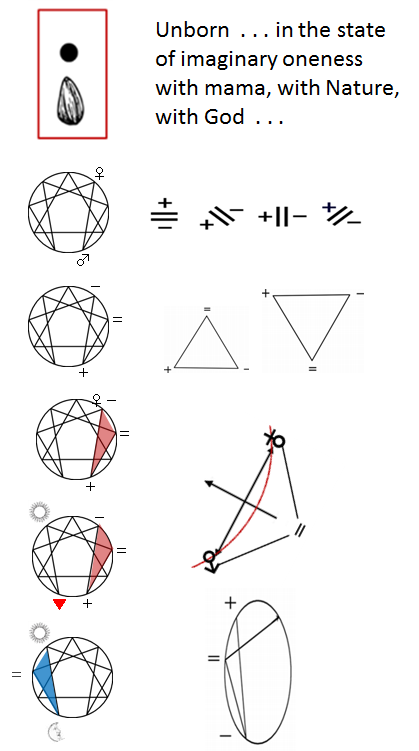
How can such an immature man, a baby immersed in dreams, have a real relationship with a real woman? But one should not have sex with one(s mama or with its substitute. But, such a case of boy's immaturity in sex relationship had become by then a typical case in Britain, feverishly covered by D. H. Lawrence because it was his own case, which he never seemed to have overcome even after Sons and Lovers. The story of a woman-dominated relationship between Birkin and Hermione, which ends violently like in the case of Dukes and Vera, can be inspired by what he heard about them although it must have been his own story too. Lawrence is likely to have been aware of their relationship as Katherine Mansfield evidently was when she wrote A Dill Pickle (1917). A similar case of child-mother type man-woman relationship was repeated by J. G. Bennet with Lady Beaumont of Constantinople, after he found that his relationship with his young wife had become uninteresting after his spiritual awakening, so to say, triggered by his out-of-body experience induced by injury he suffered during the war. I mention this because Bennet is the person about whom Gurdjieff specifically is reported to have said that he had the second body, but not the third, which destines him to remain 'a taxi' without a driver. How poor! How stupid! Gurdjieff, particularly in the chapter of India in Beelzebub's Tales to His Grandson, emphasized the misery of having formed a second body but not the third: Blessed is he who has a soul, blessed is he who has none, but woe and grief to him who has it in embryo. Normally, the second body (=) of a man is crystallized from a sound opposition between the first body (-) and the third body (+), where the first body stands for the body we know, this physical, organic presence of man, while the third body is a body of awareness one may develop in life/
Nut, but, but . . . ut more often than not, it develops poorly because it is against the first body of man, it is not quite comfortable for the first body to have it: So, mamas, particularly if they are like angels, do their best to prevent boys from growing such a distributing thing in them: 'Nevertheless,' I argued obstinately, 'I won't say it was exactly pleasant, especially the first time.' (from Chapter 7) So, one is tempted to satisfy oneself with a low-quality second body by substituting the real body of awareness with dogmas and fantasies one can get easily from outside, like a certain Moses Turner who amused him in his childhood. In fact, he had never been interested in awakening. His interest was in remaining undisturbed in a state of hypnosis produced by the words of the magician: Gurdjieff tells the following story: At last the magician found a remedy. He hypnotized his sheep and suggested to them first of all that they were immortal and that no harm was being done to them when they were skinned, that, on the contrary, it would be very good for them and even pleasant; secondly he suggested that the magician was a good master who loved his flock so much that he was ready to do anything in the world for them; and in the third place he suggested to them that if anything at all were going to happen to them it was not going to happen just then, at any rate not that day, and therefore they had no need to think about it. Further the magician suggested to his sheep that they were not sheep at all; to some of them he suggested that they were lions, to others that they were eagles, to others that they were men, and to others that they were magicians. And after this all his cares and worries about the sheep came to an end. They never ran away again but quietly awaited the time when the magician would require their flesh and skins.: (from In Search of the Miraculous) A person in such state of hypnosis dreams of having two bodies while in fact having only one, the second being an imaginary second body, or an 'astral' body: Paul Dukes writes as follows in Chapter 16: When we enter the world we are provided with only two things: a body, and time. Then repeats again in Chapter 17: A simple aspect of this teaching which may well serve as a new starting-point to-day . . . is the elementary fact that when we come into the world we come endowed with only two gifts: the body, and time. A normal person will not see himself like this, He sees that he has only one body, which is constantly under the effect of time. This realization may lead him to a real search which may bring to him to the discovery of principles by the working of which the process may be reversed, forming something in him which may really reverse the effect of time. * * * A person with an imaginary second body is likely to lose forever the possibility of competing one(s development in such blessed manner. Or, it may be said, that those who are not interested in going that way, either because of giving up, mistrust, or because of confidence in one's ability to deceive, satisfy themselves by developing such an imaginary second body, and even take it as their obligation to help others have one. They form their own world of spirits and ghosts, all equally soulless, often seeking relations with living ones, It is interesting how living ones with imaginary second bodies may have relations with dead ones who kept their imaginary second bodies alive. Dukes reports how he and his friends communicated with them in spiritual séances, received letters and presents from them, until things finally became violent. This will be covered by the next episode: Friendship with Ghosts.
Plavan N. Go |