|
Epoxides from The Unending Quest by Pau Dukes
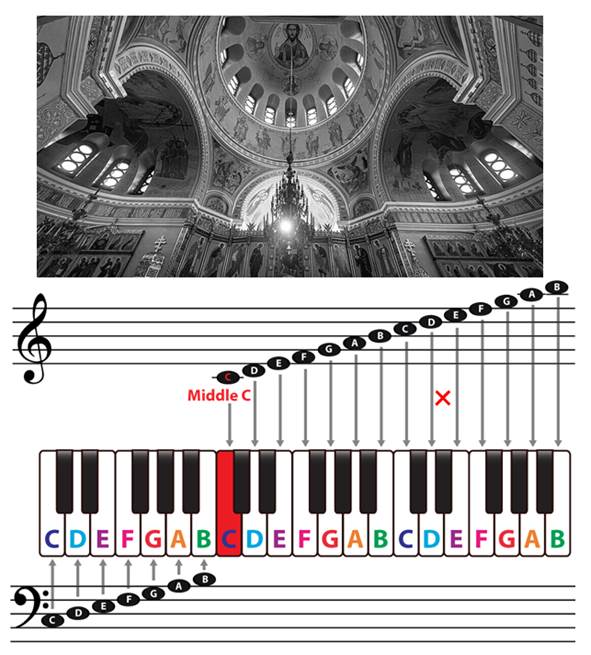
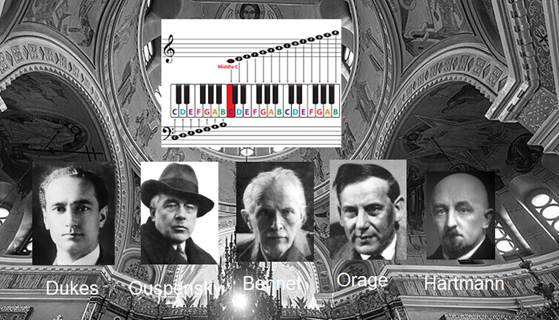
Available from Amazon in JP, CA and AU. See a related video on YouTube. 3. The Known Future This is continuation from Episodes 1, 2, and 3/ During the holy week before the Easter of 1914 that preceded the war, in the Holy Trinity Cathedral of the Alexander Nevsky Abbey, where he visited according to the advice of Prince Ozay who told him to listen carefully of whatever he might here because he might hear the echoing of the Name, his attention was taken by ta young priest, whom he later finds out was known to Prince Ozay, who read from the Bible: He begins on a note about an octave below middle C, rising one semitone with each phrase, at the same time swelling the volume. Already at the dominant his voice resounds in mighty waves among the vault's and arches. When finally, at the octave, he reaches the climax of the 'reading' the note is like a last trump—triumphant, exultant, majestic, overpowering. (from Chapter 7) After a while, this becomes unbearable to Dukes: When he reached about E-flat I noticed something quite extraordinary happening in his voice. He appeared to be 'directing' it in a certain way (that is the only expression I can find to describe it) . . . I did not hear the effect, I felt it—piercingly, almost like a pain, analogous to the pain one feels in the eyes when moving abruptly from gloom into a brilliant light. He achieved this strange effect only on certain vowels, and on these I felt the sound as if it was being produced in my own head and throughout my own body. I seemed to be identified with it, and its effect was to make everything around appear to swim and for a moment to become unreal and ethereal. I was afraid I might totter and fall, and had to pull myself together with an effort. It was a disconcerting experience. (from Chapter 7)
A full reading of Duke's autobiography, The Endless Quest, may give the reader a good idea about what this might signify because the 17 notes up to the fatal E flat correspond to the its 17 chapters: C - 1. First Lap D - 2. Lon. Mat.—The Road to St. Petersburg E - 3. Into the World of Music F - 4. Into the Spirit World G - 5. Another Kind of Spirits A - 6. 'Holy Charlatanry' B - 7. The Lord's Prayer C - 8. Noah's Ark D- 9.Yoga I E - 10. Yoga II F - 11. Thought for Food G - 12.'Acrobatitis' A - 13. The White Lady of the Stars B - 14. Egypt C - 15. Astra Necessitant? D - 16. Searching for Methuselahs X - 17. The Real Gospel of the Kingdom of Heaven In repeating the octave for the second cycle (Chapter 8), Dukes is aware that he is repeating, imagining that he is entering into a new stage of life with a more developed man. This can be a point of argument because, side by side with certain signs of development, there seem to be some unmistakable signs of regression, back to mama, not only to her milk, but back to the security of womb, a theme repeated by Dukes again and again like an obsession. This time, he confines himself in "The Ark" which is a boat moored off the coast of Long Island, amusing himself again by making himself popular among children in the role of Uncle Moon. Although he does not tell, a background of such seclusion might have been the fear of revenge, which eventually might have been the real cause of his death by car accident. Later on, after his marriage failed in 1928, he secluded himself in the spa resort of Divonne-les-Bains. There, during a long fasting, he seems to have attained to a temporary awareness about the downward trajectory of his life, but not of much depth, as he appears to be an expert in picking himself again. So, he goes into an new adventure in acrobatic dancing with no one less than Nadine Nicolaeva of Russian Ballet, with whom he is rumored to have entered into a romantic relationship, another affair with a wife of another man. In such repetitions, it must be quite difficult to judge whether one is going up or down, as he must have been thinking that, each time he was becoming more successful in spite of what he came to realize during his long fasting: Together with successes, failures and follies are revived with ruthless poignancy, almost too cruel to be borne. Heaven and hell interchange, overlap, coincide. A peculiarity is that the normal propensity to console and deceive oneself with the best interpretation of things completely evaporates, things reappear simply, as they really were, so that some imagined successes, stripped of tinsel, emerge as ghastly, grinning skeletons. (from Chapter11) After he escaped from Russia, from his enemies there, and from Prince Ozay, and restarts his life in America, his spiritual interest regressed back to such a degree that, while taking a trouble to visit the doomsday cult community of Alexander Dowie for whatever interest, he seems to ignore or pretend to ignore when Ozay, now Gurdjieff, sailed to New York in early 1924, he being busy trying to learn tap dancing, giving lecture tours, socializing in a community, often described as Tantric, formed ni Nyack around Pierre Bernard , the substantial starter of American Yoga. In this second half of this renewed octave, Dukes meets White Lady of the Starts, who could be as threatening as Ozay to his spiritual sleep. Dukes behaves with her basically in the same way he had behaved with Ozay, and as White Lady dies in Chapter 15, his spiritual life comes to an end. The remaining two chapters are superfluous, most readers will see the author dead. What a book! 'Seeking and seeking, fibbing [lying] and fibbing . . . to hide your designs and intentions from those around, I suppose. . . . 'Didn't you beg me to tell you the whole truth as I saw it written in the stars? I did tell you the truth, but you chose your own path. Why should I cast my pearls.'
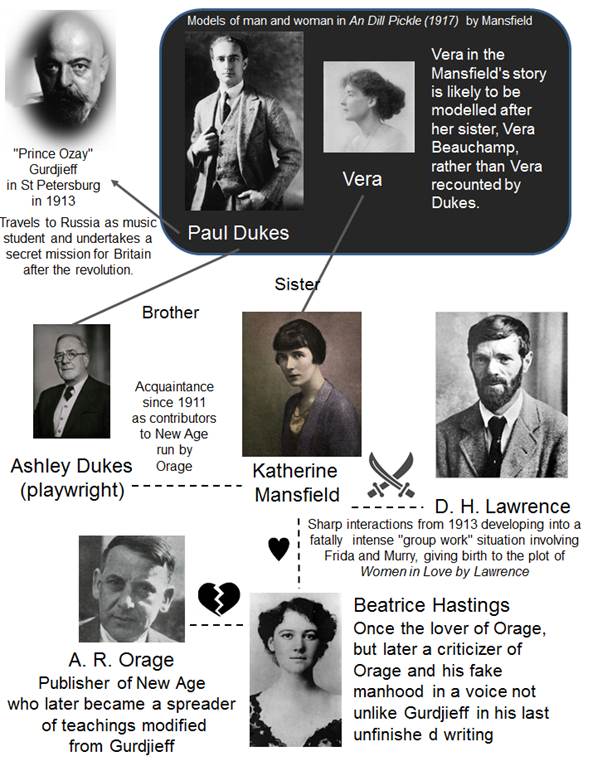
A Dill Pickle (1917) by Katherine Mansfield captures the image of Paul Dukes at the time of his temporary homecoming in 1917 after he finished his relationship with Vera, believing that he has become more developed as an independent man, thanks to his meeting with Prince Ozay and his teaching, but whom he in fact could not follow. This is probably the subtlest of her short stories because of her capturing of all these elements. This story, written ion the base of a story known as An Onion in the Brothers Karamazov, could be taken as a story telling about the impossibility for anyone to save a woman steeped in a kind of negativity typical of woman, addicted to using it as a weapon, because, for such a woman, that negativity is like her soul, her identity, she has nothing else to cling to. In the story, her name is indeed Vera, but this is also the real name of Mansfield's eldest sister, a character who appears as Isabel in some other short stories of Mansfield. The man is evidently modeled after Dukes, and as he indeed looks different from how he was several years ago, more manly, independent, partly as a result of having learnt a certain 'system' while he was in Russia. He sees the negative state in which Vera is, tells stories about his journeys, which tickles her mind, makes her almost want to change the course of her life, but she is not quite trusting, as memories of how he was in the past, keep on bothering her: Has this man really grown up? Could he be in fact the same as before? This mistrust in the possibility of a boy being transformed into a real man might be out of her attachment to her own negativity, could be mostly so, but yet, but she might have been simply seeing him through. She gets up and leaves, butting the onion, which, in this story is suggested by the title and depicted by her glove, with which the man tries to pull her back. Bye, bye. The man hurriedly tries to tell her about the system he had learned, with which he might save her. No, he did not get to the point of telling her about Ozay. Well, it this was indeed the case of Dukes, what's good in telling her about Ozay and his teaching as he himself had lost connection with it. He had let go of the onion.
'Nevertheless,' I argued obstinately, 'I won't say it was exactly pleasant, especially the first time.' 'Young man,' he answered severely, 'do you condemn the sun because it blinds you to look at it, or fire because it burns if you to touch it, or your muscles if they ache from strain? Truth must always be revealed in small doses, greatly diluted. And sound, too, has to be rationed, especially the Name which is above every Name, as your scriptures express it. That is why the Name must be hallowed. An overdose might easily kill you before you're trained for it.' . . . 'Are you afraid of risks?' he said, gently once more, but still with a note of reproof. 'Understand this clearly. No man can acquire this kind of knowledge without risking death. God, misapplied, is the Devil. There is only one force in creation. Good and evil lie merely in its application.' (from Chapter 7) It seems that, from this time on, the Duke's quest took a new turn: it became a search for one way or another by which he might deny this. Thus, it became a quest for the impossible: how to attain to the kingdom in heaven without taking the risk of being transformed. Searching and searching, deceiving and deceiving himself and also others, as the White Lady of the Stars saw it.
Horribly enough, a similar path was travelled by many others: Ouspensky, Bennet, Orage and Hartmann, The last of those names could be James Webb, a historian who did an extensive historical research focused particularly on Gurdjieff, Ouspensky, and Rodney Collin in a huge book titled The Harmonious Circle, in which the identity of Prince Ozay as Gurdjieff was first suggested. What was the motive behind this enormous research work: to convince himself and others of the inadequacy for anyone to attempt following a man like Gurdjieff, evidently not a gentleman, probably of a dubious background, who ruined the lives of many decent people who tried to follow him, and prove the superiority of more gentlemanly teachers like Ouspensky. He could not really prove the "dark hidden side" of Gurdjieff although he collected episodes of his harsh treatment of certain students, inhabited behaviour, and rumors of someone as important as Alexander de Salzmann died cursing Gurdjieff. Next, his desire to prove the superiority of Ouspensky turned out to be almost a total failure in spite of his eager attempt to justify him as he found deceit after decrepit in his life as a teacher which ended in fiasco, In despair, he in vain tried to glorify Rodney Collin, saying that he seems to be a "good man," dedicating the title of the book to a concept that represented his philosophy. Rodney Collin dies mysteriously in South America by jumping from the top of a cathedral, Hames Webb shot himself to death soon after the publication of this book in 1980. Looking at those examples, people tend to think that meeting a master like that is a disaster although a sane thinking man should be able to see it is not. Gurdjieff is reported to speak about this as follows in Chicago, 1924: Everyone, up to a certain point, many even until their death, believes in the solidity of the ground on which they advance in their lives. But if you realized that no balance exists in you, that your moral and psychological stability is based on spiritual blindness, that no one, including you, can do anything . . . and if you were convinced that you are all walking towards a precipice where you will disappear into nothingness, then you might see the benefit of knowing where this path you are walking on leads to. I know this path [into nothingness] and wish you [stop following it so you may] avoid suffering and gnashing of teeth. (From a Memoir by Tchesslav TCHECHOVITCH) In 2003, I was contacted by Dushka Howarth, who insisted on her control over the distribution of the Movements based on a view that the practice can be dangerous. Yes, the practice can involve risks if the kind discussed above because movement in itself is a measure of truth, as in the example of lie detection, and the way students respond to canings from the Movements and the group situation formed around their practice tell quite a lot about themselves, about their conditionings from the past and their inevitable consequences , almost always testing the limit of how much truth they might bear. But, should people be overly protected from them? I found her insistence of Dushka being political rather than sincere, and the argument ended in her having a dangerous heart attack. In my opinion, if the distribution of the Movements should indeed be controlled, it should rather be controlled in such a manner to prevent them risks from being compromised by being made available as commodities in the consumer spirituality market. It is true that those who approach what I am talking about sense fear and even experience it, but it is not their real self that experiences it, it is something else within them, so this fear is not the fear of your essential being. Rather, all rubbish in you that you must abandon makes you afraid, as it want you to continue walking on the same old path. A group of parasites and slaves, that exist in man becomes alarmed by the danger of what awaits them when the man becomes awakened to reality. So, they create this fear, trying to give rise to the impulse of rejecting everything that come from me. If we are to compare the joys, balance, and organic well-being of people who are heading toward nothingness without knowing it, and the suffering and unhappiness experienced by those who know they are heading toward annihilation, the difference lies in the fact that the former know nothing, and the latter suffer from the remorse and reproaches from the awareness of what they have done. But, objectively, there is no question of choice between the two. A gardener removes weed from the ground without any remorse because it is necessary to do so to support growth towards flowering. It is the failure to take advantage of such conditions for growth that that would result in real suffering. (From a Memoir by Tchesslav TCHECHOVITCH) The real danger exists more in how, after such meeting with a master, such contact with the higher, or such revelation about oneself, one may try to cover it up and manage its impacts through various measures of adaptation and deception. As a virus or beast that survived an attack from a higher species may become more tenacious in its ability to defend itself and to engender others, one may strengthen oneself and transmute oneself into a source of harmful influences. Trying to be helpful and being a missionary are among typical measures of self-defense. Thus, a man like Gurdjieff eventually is forced to do something that may appear unjust to those who have followed him persistently but obstinately. The work of every man can proceed in three directions. He can be useful to the work. He can be useful to me. And he can be useful to himself. Of course it is desirable that a man's work should produce results in all three directions. Failing this, one can be reconciled to two. For instance, if a man is useful to me, by this very fact he is useful also to the work. Or if he is useful to the work, he is useful also to me. But if, let us say, a man is useful to the work and useful to me, but is not able to be useful to himself, this is much worse because it cannot last long. If a man takes nothing for himself and does not change, if he remains such as he was before, then the fact of his having by chance been useful for a short time is not placed to his credit, and, what is more important, his usefulness does not last for long. The work grows and changes. If a man himself does not grow or change he cannot keep up with the work. The work leaves him behind and then the very thing that was useful may begin to be harmful. (Gurdjieff quoted in Chapter 11, In Search of the Miraculous)
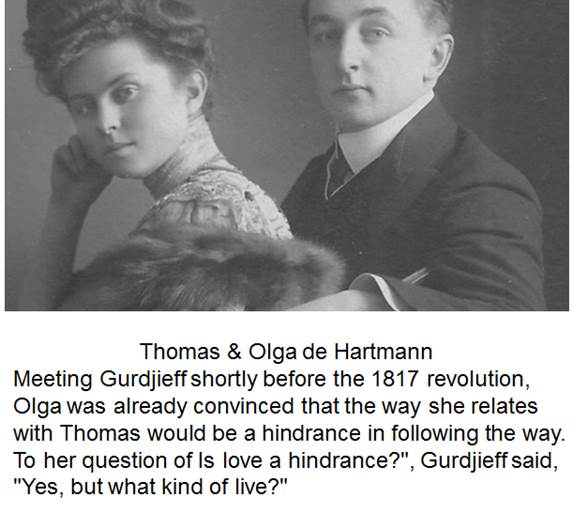
The Hartmanns left Gurdjieff in 1930, never to see him again. To Louise March who replaced them as a new German secretary, soon to be nicknamed Sausage, Gurdjieff told how they had been terrible, stubborn, insolent. Dr. Stjoernval, a longtime associate of Gurdjieff, commented: 'May I say something to you? How to explain it? Gurdjieff tries something that no one has tried. He tries to take a person born under one star and change their destiny to that corresponding to another constellation. And that is, in general, impossible.' (From Louise March, The Gurdjieff Years) This story about the Hartmanns was in focus in my first meeting in 1988 who KM who had been related with the main lineage of transmission from Gurdjieff. The Japanese woman, who had spent years in Ney York with a Foundation group there, was preparing to publish the Japanese translation of the memoir written by the Hartmanns, and Mr. W of the publisher that had been publishing many books of Osho and a few of Gurdjieff was also in the meeting. I was surprised to hear Mr. W's mistrustful remarks on Gurdjieff:. "I would never want to follow a man like this, Will you," he asked me. "I think I will," I said. Then, Mr. W asked KY, "Are there stimm some group leaders in the Foundation who can have such an impact on the lives of the group members." "Such ones have already ceased to exist," KY said, then turned to me, bonbarded me with criticisms, and told me that unless I get totally transformed through meeting with a living master, I should not think of something like translating Gurdjieff's books. But, where is such a place now? Then, Mr, W mentioned Osho, expressing his appalment about how much risks his sannyasins take in following him. KY, said, "Yes, he could be equivalent, although he is vulgar." Then, I spent years in the Commune in Pune that had been formed around Osho, but when I went there, I initially did not know that I was going to be involved in the reviving of Gurdjieff's Movements there. There, at that time, the energy level was so high that one could feel uncomfortable spending a long time there as it was too revealing. My first marriage did not endure for a month. It is difficult to deny that the formation of such a space depended largely on the use of what could be close to fraudulence. However, in this case, the fraudulence was more or less deliberate, out of necessity, and Osho seems to have suffered and perished from its consequences. In most of us this common language I speak about is irretrievably lost. The only thing left us is to establish a connection in a roundabout, "fraudulent" way. (Gurdjieff, January 19, 1923) By misrepresenting all masters of the past including Gurdjieff, speaking as if on behalf of them, and bringing together different approaches, that merged and collided around him, he created around him a huge communal phenomenon, a melting pot, in which one could die and get reborn., Today, when it is gone, you are unlikely to see its benefits, but I received the maximum benefits and impacts from it while it lasted, so I am not personally in a position to condemn the harms although I understand the position of the criticizers. Plavan N. Go |