|
The Unending Quest Pau Dukes
Introduction
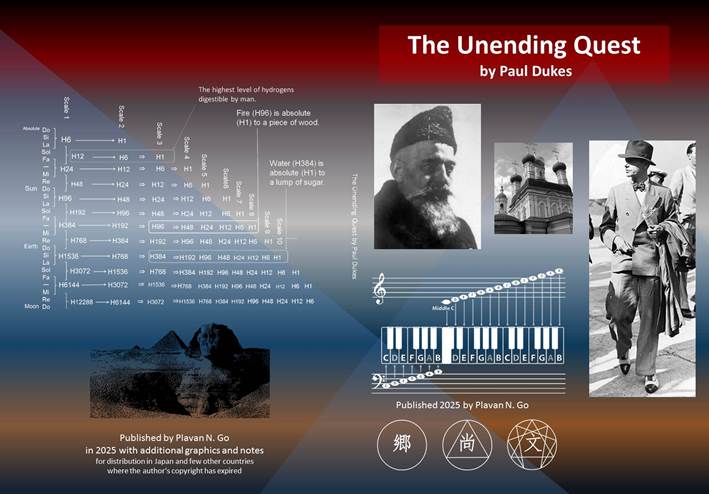
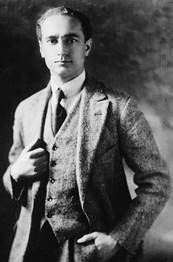
This is an autobiographical account by Sir Paul Dukes, known for his adventure as an M16 agent in Russia after the revolution, of his musical career and spiritual Wandering-about, which was impacted by his meeting with Prince Ozay (evidently Gurdjieff) in St. Petersburg in 1913. The book was first published 1950 in Great Britain. This edition was published 2025 by Plavan N. Go with additional graphics and notes for distribution in Japan and a few other countries where the copyright of the author, who died in 1967, had already expired.
The identity of Prince Ozay as Gurdjieff was first suggested by James Webb in The Harmonious Circle (1989) and then definitely affirmed by James Moore in the biography of Gurdjieff (1991). It appears quite certain that Ozay was Gurdjieff, but as to the status of Dukes as a faithful follower of "esoteric Christianity of Ozay,' the reader may come to a different opinion after the full reading of the book. However enthusiastically Dukes may assert it, he turns Ozay into a fictitious character after 1914. Dukes had been married in New York for two years when he sailed there in early 1924. Dukes does not mention this event that he could not have missed, while strangely beings to mention Gurdjieff later in the book in connection with P. D. Ouspensky to whom he became acquainted. Dukes separates Ozay from Gurdjieff, as if they were different persons, just as P. D. Ouspensky, to whom he was personally related, treated Gurdjieff before and Gurdjieff later.
In spite of his faithlessness with descriptions of illustrious chargers, some of them , like Tara Bay (could be a model for Ekim Bay mentioned by Gurdjieff) and the White Lady , sharp enough to point at the fatal weakness of Dukes as Ozay did:
"What you seek you will not find, even
though you may come across something greater than what you seek" The quest becomes endless as the seeker is in search of the impossible: to attain to the higher without accepting the risk of being transformed by it. The book covers what looks like the entire spectrum of so-called "spiritual" trips, tricks and stunts, that are typically attempted by half-hearted seekers. Dukes in this way seems to have set a model for many others to follow: P. D. Ouspensky and others, today forming the main stream of what is called the Fourth Way or the Gurdjieff Work.
Plavan N. Go
-----------------------------------------------------
THE UNENDING QUEST Autobiographical Sketches
And woe to man, if under the influence of the poison of what seems Truth, and striving after 'practical' results without possessing a perfect understanding and knowledge of what must be done and how to do it, he starts experimenting on himself, often doing himself irreparable harm. Harmony is destroyed and it is incomparably better to do nothing at all than to do without possessing the knowledge. (G. Gurdjieff from the transcription of a lecture on the enneagram in Moscow, 1916) -----------------------------------------------------
Contents: 1. First Lap 2. Lon. Mat.—The Road to St. Petersburg 3. Into the World of Music 4. Into the Spirit World 5. Another Kind of Spirits 6. 'Holy Charlatanry' 7. The Lord's Prayer 8. Noah's Ark 9.Yoga I 10. Yoga II 11. Thought for Food 12.'Acrobatitis' 13. The White Lady of the Stars 14. Egypt 15. Astra Necessitant? 16. Searching for Methuselahs 17. The Real Gospel of the Kingdom of Heaven Notes (Plavan N. Go)
-----------------------------------------------------
Notes (Plavan N. Go)Paul Dukes writes as follows in Chapter 16: When we enter the world we are provided with only two things: a body, and time. Then repeats again in Chapter 17: A simple aspect of this teaching which may well serve as a new starting-point to-day . . . is the elementary fact that when we come into the world we come endowed with only two gifts: the body, and time. How do you find this statement? Do you agree? Is this the truth? What strikes me as being strange is the emphasis of two. Why two? Are they two? What is the second? An imaginary second body, a phantom self? A normal person would see only one: only this body that is constantly under the effect of time. For a normal person, this is the beginning of a search, that might bring him out of a juvenile state in which one keeps on believing in the most juvenile state of being comfortably closed up in the body, dreaming of eternity, like an ancient Egyptian might have done in the confinement of a closed space in the pyramid.
How do you find this statement? Do you agree? Is this the truth? What strikes me as being strange is the emphasis of two. Why two? Are they two? A normal person would see it as one: that he was born only with this body that is constantly under the effect of time. For a normal person, this is the beginning of a search, that might bring him out of a juvenile state in which one keeps on believing in the most juvenile state of being comfortably closed up in the body, dreaming of eternity, like an ancient Egyptian might have done in the confinement of a closed space in the pyramid. 'Up out of Egypt I have called my son.'
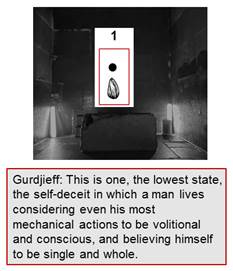
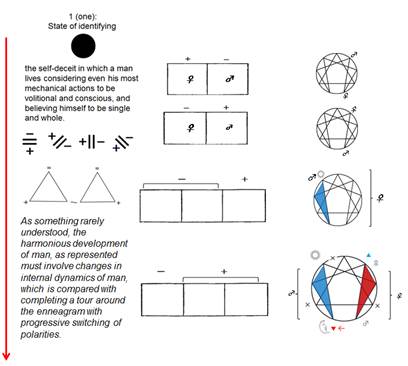
Gurdjieff: This is one, the lowest state, the self-deceit in which a man lives considering even his most mechanical actions to be volitional and conscious, and believing himself to be single and whole.
No, he would not come out as he believes that the Kingdom of Heaven is hidden there. He keeps on going back there, recoiling from contacts with the higher while being ready to submit to the lower: On the other hand the special exercises contained in the Sermon on the Mount and other portions of Christ's teaching—not to resist evil but turn the other cheek . . . Gurdjieff tells the following story: At last the magician found a remedy. He hypnotized his sheep and suggested to them first of all that they were immortal and that no harm was being done to them when they were skinned, that, on the contrary, it would be very good for them and even pleasant; secondly he suggested that the magician was a good master who loved his flock so much that he was ready to do anything in the world for them; and in the third place he suggested to them that if anything at all were going to happen to them it was not going to happen just then, at any rate not that day, and therefore they had no need to think about it. Further the magician suggested to his sheep that they were not sheep at all; to some of them he suggested that they were lions, to others that they were eagles, to others that they were men, and to others that they were magicians. And after this all his cares and worries about the sheep came to an end. They never ran away again but quietly awaited the time when the magician would require their flesh and skins.: The Gurdjieff's dynamic vision of harmonic development of man is far away; it is in fact something that he is protecting himself from:
What is the price for seeking complacency in such juvenile state of existence? 'Liebe!' She laughed horribly, repeating her prediction of unlucky love. 'Erste –zweite-dritte - Unglucklich! Unglucklich! Unglucklich!' Another inevitable consequence is the vainness of self and of existence. In spite of his assertion that something higher is bound to develop within the body, the very physical body which is constantly under the effect of time. the main impression , almost unbearable, that the reader is likely to receive while reading Chapter 17, which corresponds to a note before the fatal E flat, is the emptiness of his words. In his preaching on the way to Heaven, full of quotes, there seems to be nothing of himself. So absent are the particles of understanding that have become inseparable with his being, that could have served as materials for genuine individuality. Instead, he remains as mature as before, trying to trick children and ignorant ones, seeking popularity among them, repeating the role of Uncle Moon.
James Moore, in his biography of Gurdjieff (1991), was the first to identify Prince Ozay as Gurdjieff with definite confidence, but he was naive in commenting: Although in his rich later life Sir Paul Dukes concentrated on yoga, he generously acknowledged his fundamental debt to Prince Ozay's 'esoteric Christianity' How this historian could be so blind to the falsity of his claim. In fact, he was very far away, there could be no contact between he and Ozay. 'I could kill you in an instant, sitting here, without either of us moving a muscle.' I think Ozay was serious in his desire to kill this young man. Similarly misguided was the another commentary from James Moore: Was Gurdjieff ever tempted to present his teaching explicitly in Christian terms? What? It would have been fatal. However Gurdjieff wanted it to be otherwise, whatever he gave out continued to come into the hands of one Uncle Moon or another, misapplied, creating sensations, attracting many. As they took over the "Work" scene, Gurdjieff was stranded in a situation not unlike the White Lady of the Starts just in the same period from 1936 to 1937.
Plavan N. Go
|