|
|
|
|
Home | Videos | Group | Articles | Journeys | Plavan N. Go | 日本語 |
|
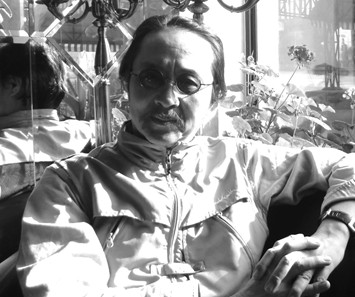
Plavan N. Go 郷 尚文
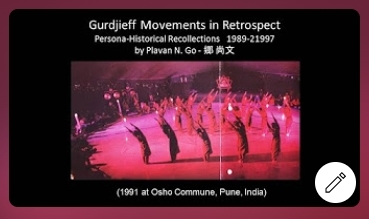
In Alexandropol Since coming in contact with the main lineage of transmission from Gurdjieff in 1988, but without becoming a part of it, I followed the advice of a person in that lineage to visit the Osho's Commune in 1989, several months before his death. and then, unexpectedly, I involved myself in the attempts that took place there of reviving Gurdjieff's Movements there according one of Osho's suggestions in his final period. After that, I had interactions, often intense, with groups and indivisibles that were connected with the transmission of ideas and practices that came dawn from Gurdjieff. I started leading group work and Movements practice in 1997. The videos show scenes from the programs I have led in India, Japan Russia, and Turkey. My name, Plavan, the Sanskrit root for pleuvoir in French, comes from the opening chapter of Thus Spake Zarathustra by Nietzsche on which Osho has spoken.
Personal-Historical video series; 1 2 3 4 5 My first contact with the main lineage of transmission from Gurdjieff was through engagement in the Japanese translation of Gurdjieff's Beelzebub's Tales to His Grandson. A person from the New York group of the Gurdjieff Foundation, whom I met on account of this, told me of the more primary need to learn in a vital situation formed around a living master, and surprisingly suggested me of paying a visit to the Osho's Commune in Pune, India. Nearly 10 years after that, I resumed the translation, and published the book, followed by others, making a complete series of literature and recorded materials from Gurdjieff. In addition, I published books of my own writing, the complete series of Katherine Mansfield short stories in Japanese, and new translations of the Rainbow and the Women in Love by D. H. Lawrence. I owe my training in literature to my father and to Masao Shimura (1929-2022), an accomplished professor in American literature, a genuine seeker himself, with radical view on Zen and mysticism. His lectures on The Crying of Lot 49 by Thomas Pynchon, addressing the secrets of the laws of world creation and maintenance resisting the action of Time, prepared me to understand the background of Gurdjieff's Beelzebub's Tales to His Grandson. After graduating from the university, I worked for a few years at a large automobile component manufacturer as a member of the overseas business division, on account of which I unknowingly continued a close relation with the Y family in Taiwan, the patriarchal head of which, only after three years, revealed his identity as the head of a masonic society, a bridge between the Chinese esoteric tradition with the American lodge connected with Ford, as he invited me for the first time into a temple behind his office, telling me to read from a sacred book placed on the podium: "The force is not power. It is not wasted like gunpowder in explosion . . . " The room had photographs of the Y brothers in full costumes of knights. Rather than the scene being am imitation of the George Lucas movie, the reverse was the case. The clan name of the Y family was represented by a 15-stroke Chinese character that symbolized the following principle in Chapter 44 of Beelzebub's Tales to His Grandson: "the effects of a cause must always re-enter the cause." Obviously, their gesture toward me suggested their understanding of a corresponding symbolism in my name. From 1988 to 1989, I worked for Fujitsu, assisting the first-generation AI development in the role of linguist, trying to apply the verb-centered syntax analysis technique derived from the Fillmore's case grammar theory to relate the structures of human perceptions to sentence structures, a graphical representation of which serving as a universal language, so to say. A remarkable attempt that could revolutionize the way one thinks as one begins to "see" with a higher mind the forms of one's thinking. Though technically not successful, and was substituted by the associative language processing technique of today, this training I had in this technique probably gave me an unusual ability to connect seeing and thinking, which resulted in insights into the enneagram, into the working of the laws that it reporesents, and into the language of forms represented by the Movements from Gurdjieff. Going back to my earliest education at school, I was one of the kids going to the Konodai Elementary School, like the ones depicted by Hisashi Inoue, who moved in to our neighborhood, in his novel Nise-Genshijin (in imitation of the Original Man. A remnant of ancient men's dwellings (map) that exists the area recalls in boys like me in the neighbourhood a memory of the Original Man, causing them to rebel against their education-crazed monstrous mothers in a group-based attempt to eliminate them one by one in a desperate effort to protect their boyhood. In the same period, I was exposed to the influence of the fast (active) school of Zen as I attended Zazen and sword practices at the dojo of a radical fourth-way Zen movement that originated from Ryobokai (Society for Departure from Duality), which was formed in the Meiji period by a group of illustrious figures, variously talented in literature, sword, art, or actively involved in liberal social activities with the support of the abbot of Engakuji, Kamakura, of the Rinzai school of Zen, with which, D. T. Suzuki and some Gurdjieffian figures including Madame de Salzmann came to be associated. Next to the dojo was Shikiba Hospital, a renowned psychiatric treatment institute with a well-cared rose garden. A character modeled after Dr. Ryusaburo Shikiba, abbot-like chief of the institute, appears in the above-mentioned model in a rather ignorable role of a doctor who applies therapy to one of the rebellious schoolboys to bring him back to "normality" and to his mama. The doctor in his real life was known as the discoverer of the ingenuous artistic talent in Kiyoshi Yamashita who otherwise was considered a mentallu handicapped man who loved travelling like a vagabond, thus confirming the idea that there are indeed two minds in man of which the development of one is often at the cost of another. But the doctor finds him guilty of stressing him by making him adapt to the expectations placed on him by those who were surprized by his talent, testifying his unusual capability to absorb and store impressions.
Atimoda, who represents Osho non-TM Tara Meditation Center, travels with me since 1997. When not traveling, we stay at our house in Koyoen, Nishinomiya, Japan. Contact: |
gurdjieff-osho.namaste.jp